![]() |
||||||||||
|---|---|---|---|---|---|---|---|---|---|---|
The Mountain Man Mandala
Outer
| Outer
| Inner
| Inner
| Web Publication by Mountain Man Graphics, Australia - Southern Summer of '97
![]() | ||||||
Living Systems, Science & Consciousness |
|---|
This ambitious work attempts to present an observation concerning the holistic nature of the ground of being and its relationship to the natural environment in which - it is told - the nature of living systems has evolved.
In his outline of the System's View of Life, Capra discusses the emergent properties of self-organising systems. He presents the changing paradigm away from the classical Cartesian world_view, turning towards a more holistic and less mechanistic ontology, by which the external ecological and environmental relationships of living systems are of at least equal importance to the inner componentry, in the understanding of naturally living systems:
- Fritjof Capra (1982) " The Turning Point"
Author of "The Tao of Physics" and more recently "Uncommon Wisdom",
the respected high-energy theoretical physicist Fritjof Capra draws parallels
between the manner in which the nature of the world is observed
by both the emergent scientific theories of fundamental atomic particles
and the traditional world_views of the anciently sourced mysticism.
To quote Capra again:
One of these views I will call the western scientific view.
It considers matter as primary and consciousness as a
property of complex material patterns,
which emerges
at a certain level of biological evolution.
Most
neuroscientists today subscribe to this view.
The other view of consciousness may be called the
mystical view,
since it is generally held in mystrical
traditions.
It regards consciousness as the prime reality,
as the essence of the universe, the ground of all being,
and everything else - all forms of matter and all living
beings -
as manifestations of that pure consciousness."
Global Traditions of Culture, Religion and Mysticism |
|---|
Even Christianity, traditionally seen only as an organised religion, also claimed its reclusive mystic adherents who spurned the blind conversion of the masses and the generalised and contemporary formulation of Canonical and Non-Canonical scripture which was to become included and excluded from the compilation of the christian bible respectively:
For there are five trees in Paradise for you;
they do not change, summer or winter, and their leaves do not fall.
Whoever knows them will not taste death."
(22) Jesus said to them,
"When you make the two into one,
and when you make the inner like the outer
and the outer like the inner,
and the upper like the lower,
and when you make male and female into a single one,
so that the male will not be male nor the female be female,
when you make eyes in place of an eye,
a hand in place of a hand,
a foot in place of a foot,
an image in place of an image,
then you will enter [the kingdom]."
(113) "His disciples said to Him,
"When will the Kingdom come?"
Jesus said, "It will not come by waiting for it.
It will not be a matter of saying 'Here it is' or 'There it is.'
Rather, the Kingdom of the Father is spread out upon the earth,
and men do not see it."
- Jesus of Nazareth - The Gospel of Thomas
And thus it may be perceived that the nature of the mystic tradition was not bounded by cultural beliefs, nor arose from only one part of the ancient planetary surface, nor was influenced unduly by only one of the great souls whose lives have been recorded in the historic publications of global mankind. These great souls ... Krshna in 5000BC, Buddha in 570BC, Jesus in 30AD and Mohammad in 570AD are to be seen as both leaders of the mystic tradition as well as leaders of the religious tradition. The promulgation of the socially instituted religious traditions based on the observances, study and instruction from common core of writings and records of the lives of these four mystic souls is largely the foundation of cultural differentiation.
On the other hand, it is the nature of the global mystic traditions to hold to an integrated view of the respective visions of these great souls, and perceive within their lives and teachings a commonality which reaches to the foundation of the individual living system of being.
Moreover, the expression of many elements of this mystic tradition are not restricted to the planet's major religious traditions, for many aspects of it have been expressed - to varying degrees - by the culture of all the indigenous peoples well before the emergence of western culture and down to this very century and this very day. Literary outlines of the substance of such expression can be gleaned from such publications as The Soul of the Indian by Dr Charles Eastman, born Ohiyesa of the Santee Sioux, in 1858, or indeed within many publications concerning the Aboriginal Peoples of Australia and the essence of the Dreamtime Culture. Such an outlook however, is difficult to convey to those souls who have never yet journeyed out from the hinterlands of their own cultural topography, and explored the nature of other lands and of other cultures, who have never seen first hand the common yet expectant nature of the scattered tribes of man, and the individuals reclusive therein, and the living spark of brotherhood which - in every breath that they take - unites the planetary emergence of the consciousness of mankind.
In The Wisdom of the Elders, Knudtson and Suzuki critically examine both the scientific and the native ways of knowing about the nature of which the world is consisted. They also present insights into the manner in which native and scientific though are mutually enriching, and develop an array of interesting observations concerning the fundamental qualities of Native ecological perspectives, and then contrast them with the scientific ones. Then again, in its own fashion, the spirit of mystic contemplation and discovery of new frontiers is not unknown to scientific community:
The Mountain Man Mandala |
|---|
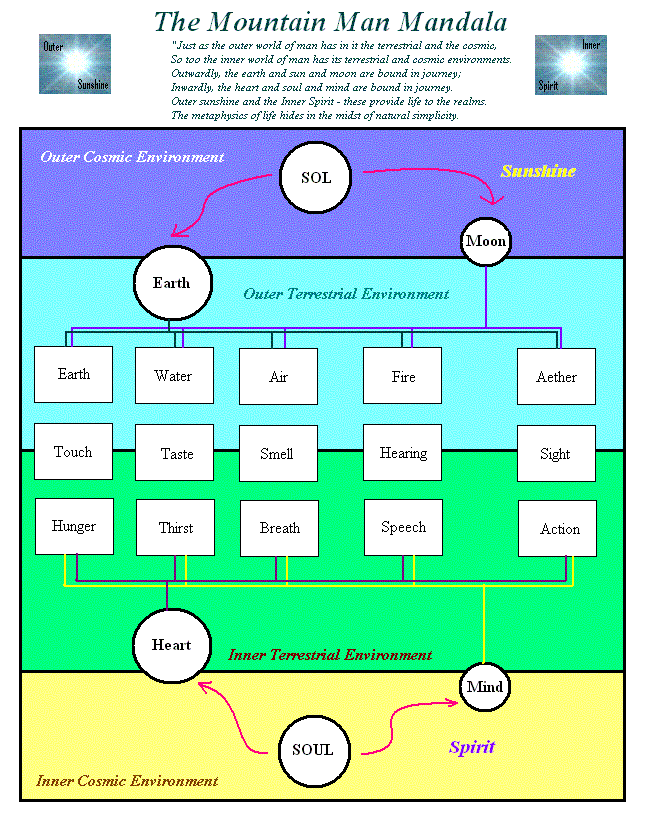
The model is purposefully simplistic and correlates the ancient elements of nature (the elements of life) to the sensory manifestation of individual consciousness.
This key concept of environmental layering explores the observations of the similarities and differences contained in the specifications of the following natural environments:
The Outer Cosmic Environment
The Outer Terrestrial Environment
The Inner Terrestrial Environment
The Inner Cosmic EnvironmentWork-In-Progress ... |
|---|
My thanks for any assistance offered.
PRF Brown
Mountain Man Graphics, Australia
Southern Summer - Jan '97
